Report from Jerusalem, #5, September 2008

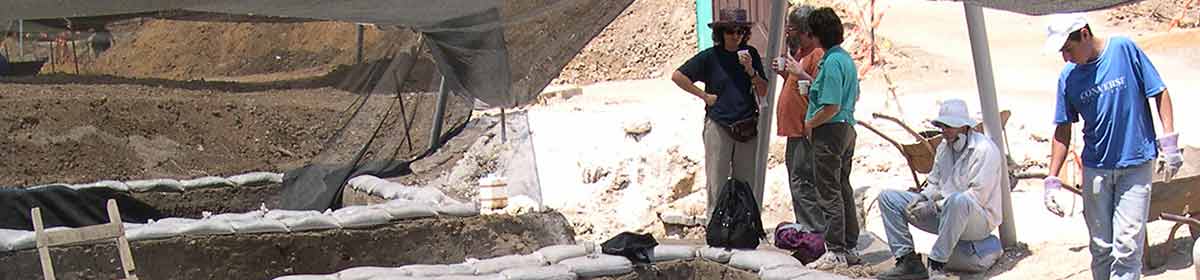
A large walled enclosure of about 30ft. by 60ft. has been uncovered in the Galilee, in the Nazareth Hills, at Kfar HaHoresh. It dates to the Neolithic Pre-Pottery B Era (8th millennium BCE) and is being dug under the direction of Nigel Goring-Morris, a British archaeologist at the Hebrew University’s Institute of Archaeology. He considers it to be a funerary precinct which acted as a regional centre for nearby villages, probably the first in this area. The site has yielded up 65 skeletons, mostly of young adult males, and an entire herd of cattle was also buried nearby. In addition there is a large number of small finds such as shell pendants, a symbolic serpentine axe, engraved tokens and phallic figurines. The variety of stone materials indicates exchange with areas such as Anatolia, Cyprus and Syria. Goring-Morris will be lecturing about the site at the Kenyon Institute in Jerusalem in November.

Reports have come in from Damascus that the jawbone of an early diminutive camel has been discovered at Khown, a desert site near Palmyra, Syria. One of the leaders of the Syrian-Swiss expedition, Heba al-Sakhel, has claimed that the bone of this desert-cruising species could be one million years old. We await further details.

Early this September, the press was shown the extensive work that has been conducted by the Israel Antiquities Authority under Yehiel Zelinger on the southern slopes of Mount Zion, Jerusalem. This work, now being continued under Yoav Arbel of the IAA, has uncovered large sections of the southern wall of the city from the Second Temple period, and another section in front of it built in the Hasmonean period, with fine bossed ashlars typical of the period of the first century BCE. After the destruction by the Roman conquest of Jerusalem in 70 CE, a Byzantine wall was built above the ruins, though it appears that the later builders did not know of the first walls. The present excavators were helped by earlier discoveries made by Bliss and Dickie, working for the PEF in the 1890s. At that time, they did not have permission to excavate from ground level, so Bliss and Dickie had to work from tunnels that they cut alongside the walls. The press was most interested in the souvenirs that were recovered from the 19th-century dig, such as beer and wine bottles, part of a gaslight and workmen’s shoes. The site overlooks the Ben Hinnom Valley, which is scheduled to be landscaped as a national park.

Regrettably, on 16th September Avraham Biran died, aged (I believe) well over 90. Biran started his career in the British civil service during the Mandate period and became the long-time excavator of Tel Dan in the north of Israel. He had been Director of the Nelson Glueck School of Archaeology and received the Israel Prize for Archaeology a few years ago. Undoubtedly full-scale obituaries will appear in the archaeological press shortly.

Rumours have been circulating about the early demise of the Kenyon Institute (formerly the British School of Archaeology) in Jerusalem and I am happy to say that they are untrue. The new director of the Institute, Jamie Lovell, has inaugurated an extensive series of lectures and the library has been reorganized on user-friendly lines with new movable shelving.

Finally a curious report in Ha’Aretz and the Jerusalem Post detailed the unearthing of a medieval town in Russia that is claimed to be the city of Itil, the capital of the Khazar kingdom, near the Caspian Sea, which converted to Judaism in the tenth century CE. The work has been conducted by Dmitry Vasilev of the Astrakhan State University and supported by Yevgeny Satanovsky, director of the Middle Eastern Institute in Moscow. The city is on the Silk Route from China to Europe, which enabled the Khazars to collect taxes and become a wealthy kingdom. Satanovsky claims that they converted to Judaism so as to maintain their independence from the surrounding peoples that were practising Muslim and Christian-based cultures. We will surely hear more about this find from Russian scholars who have said that Khazar studies (previously proscribed by Stalin) are just beginning to uncover the history of this mysterious kingdom.

Stephen G Rosenberg
Albright Institute, Jerusalem

Report from Jerusalem, #4, September 2008

As the main dig season is now over, newspaper and anecdotal reports are coming in from all over the country, and it is clear that some sensational finds have taken place.

I have already mentioned the three plastered skulls found at Yiftahel in the Lower Galilee; pictures and more information have now appeared. They date from Pre-pottery Neolithic B Period of 6 to 7000 BCE and the excavator, Dr. Hamudi Haleila of the IAA (Israel Antiquities Authority), reports that they were found in a pit near a mudbrick building, The graves were under the building and the skulls were later removed and set in the house on benches, a form of ‘ancestor worship’ set up as an example to the youth. Haleila points out that similar cults were observed as far away as Syria, and 15 similar skulls are known from Jericho.

There is ongoing work repairing and cleaning the present walls of Jerusalem, and a start has been made at the Zion Gate, where the scaffolding has just been removed to show a pristine stone face. The bullet holes of the 1948 period have, however, been left in situ, and the original dedicatory inscription to Suleiman the Great has been restored.

At Megiddo, the dig headed by Israel Finkelstein, David Ussiskin and Baruch Halpern, an amazing temple of the EB1 period (3000 BCE) has been uncovered. It is about 30 m long and has a row of central pillar bases, each side of which are smooth rectangular and circular basalt slabs of unknown purpose. There is a central altar on the back wall opposite the presumed entrance. Nearby were found masses of animal bones, mainly sheep/goat and gazelle. Finkelstein calls it ‘the mother of all temples’ and says that publication can be expected by next year. This is a major and intriguing find, situated not far from the later famous central altar of Megiddo.

More small finds are turning up at Elath Mazar’s dig in the City of David. The latest is a bulla (seal impression) engraved in paleo-Hebrew of Gedalyahu ben Pashur (Jeremiah 38:1), a minister of King Zedekiah, the last king of Judah, who was captured and murdered by the Babylonians in 586 BCE.

At Moshav Ahihud in Western Galilee, 5 miles east of Acre, a large olive-production plant of the sixth or seventh century CE has been found in an IAA excavation directed by Michael Cohen. The plant includes a huge olive press and two large oil storage containers lined in mosaic and plaster. The complex may have been part of a monastery as there is evidence (from small finds) of a church nearby. The site was destroyed by fire in about 700 CE.

A study of tuberculosis, undertaken by Israeli, Palestinian and German scientists, will be examining the ancient bones excavated by Kathleen Kenyon at Jericho, to try and discover the origin of the disease, which is still a killer in many parts of the world. It is felt that the tombs of Jericho, perhaps the oldest city known, may be able to reveal how the disease developed among the early crowded conditions 10,000 years ago. The research will be conducted at the Hebrew University (HU), Al-Quds University and the University of Munich, under a grant from the German Science Foundation.

The recent dig at Zippori (Sepphoris), under Ze’ev Weiss of the Hebrew University, has uncovered a Roman Temple of the third century CE. The temple was located in the centre of the city and shows that pagan worship took place in the city alongside Jewish practice. The temple measured about 24 x 12 m and was probably dedicated to Zeus and Tyche, judging from depictions of a temple facade on Zippori coins of Antoninus Pius. Only the foundations of the temple remained and it appears that a Christian Church was built over them at a later date, thus preserving the location of cult in the city centre. Another large Roman building, of unknown purpose, was found adjoining the temple.

The date for the domestication of cows, sheep and goats has been pushed back 2000 years to the sixth millenium BCE. The evidence comes from the examination of thousands of pottery vessels showing the remains of milk deposits, including vessels from Sha’ar Hagolan, in the Jordan Valley, excavated and examined by Yossi Garfinkel of the Hebrew University, working with colleagues from UK, US, Netherlands, Greece, Turkey and Rumania. The work was published in a recent issue of Nature.

Dr. Daniella Bar-Josef of Haifa University has recently claimed that the large number of green-coloured jewellry from the Upper Paleolithic period of 12,000 years ago, collected by the Geological Survey of Israel from at least eight sites throughout Israel, were beaded amulets for human and agricultural fertility. She claims that their use came about at the transition from hunter-gathering to sedentary farming, when all forms of fertility were at a premium. The colour green was used to promote the aspect of growth, related to plants and trees, even at the expense of bringing material for the beads from sites 100 km distant.

The IAA have recently announced that all 15,000 to 20,000 fragments of the Dead Sea Scrolls will be available for viewing on the Internet within the next five years, together with a translation and interpretation of each fragment. At the same time, the project for their preservation is continuing apace.